Mobile phone repair at Karol Bagh Market

I love these pictures:
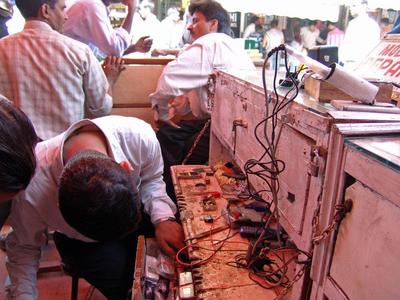
I link-blogged that article ages ago, but I keep thinking of it, so it’s worth a proper post in its own right, to expand on that.

These guys work at an Indian mobile phone repair stall in Karol Bagh Market, in Delhi. The blog entry notes:

As in China, many of the mobile phone shops and street kiosks offer mobile phone repair service. Many of these guys can strip and rebuild a mobile phone in minutes. … a lot of the hyperbole surrounding western hacker culture makes me smile compared to what these guys are doing day in day out.

Also, a commenter notes: ‘in india, for about 1$, you can convert a CDMA phone to GSM !! also, they can unlock phones and do a veriety of hacks for little money.’

There’s so many lessons I’m getting from it:

  1. I’ve had a shoe resoled in 5 minutes for next to nothing at a stall not too different from that — but this is a mobile phone. It’s amazing to think of that level of hardware hacking taking place every day at a back-street market stall.

  2. Those phones were doubtless planned, as a product, with a ’ship back to manufacturer’ support plan. That clearly isn’t going to fly without that developed-world luxury, Fedex. So this is the developing-world street finding its own uses for things, and working around the dependencies on systems that are optimised for the developed world.

  3. It’s the flip-side of Joshua Ellis’ grim meathook future, where we’re not facing down the barrel of a New-Orleans-style descent into barbarity if the power suddenly cuts out; tech can go on. It may be a little chunkier, though, and with more duct tape, but hey.

  4. It’s also a beautiful demonstration of how those of us in the developed world who assume that developing-worlders cannot find a use for high tech, are talking shit. (cf. Ethan Zuckerman as a good example of someone who gets this, more than almost anyone else I can think of.)

I think this is one of the most important lessons I learned while travelling through India and SE Asia a few years back — the developing world is using high tech, and it’s not using it in the same ways we do — or even the ways we anticipated, and we have plenty to learn from them too.

Found at Jan Chipchase’s site, which is full of great contemplation on this stuff. (The story on Seoul’s selca culture is nuts, too — it’s like Flickr^1000.)

(PS: I have a wisdom tooth extraction scheduled for next Friday… wish me luck. That’s another thing you don’t want to happen in the developing world, although I daresay it’d rock in Bangkok!)

(Update: clarification — my cite of Ethan Z was meant as a compliment ;)

Tags: , , , , , , , , ,

11 Comments »

  1. Antoin O Lachtnain said,

    November 11, 2005 @ 9:53 am

    Well, phones do have modular components. How do you think Nokia in the west fixes ‘em when they get back to the factory? They don’t have rows of PhDs armed with logic analysers, that’s for sure. I guess if you get to know all the different pieces, you can get good at swapping stuff around. In the past India has been known to standardize on a particular manufacturer to some extent to ensure interchangeability of parts. The Ford Transit van used to be the standard van, for instance.

  2. Walter said,

    November 11, 2005 @ 9:55 am

    Wow great post. It seems in the developed world the ‘hacker’ ethic springs from playfulness and curiosity. In the developing world it springs from necessity.

  3. Ethan said,

    November 11, 2005 @ 3:00 pm

    Justin - you appear to have just characterized me as one of “those of us in the developed world who assume that developing-worlders cannot find a use for high tech.” I would have thought that spending five years and over a million dollars of my own money sending geeks and hackers to Africa and central Asia to help governments, non-profits and businesses use the Internet would make it clear that I think technology’s a pretty transformative tool for the developing world.

    But since I disagree with you on the prioritization of DRM as a pressing issue for the developing world, I guess I’m just “talking shit”.

    You might want to read some more of the shit I so often seem to talk - Making Room for the Third World in the Second Superpower - for instance, before characterizing my thinking based on one blog post you disagreed with.

  4. VeerChand Bothra said,

    November 11, 2005 @ 4:02 pm

    Trackbacking: Have blogged your post here.

  5. Justin said,

    November 11, 2005 @ 6:30 pm

    LOL! Ethan, I meant exactly the opposite.

    I picked you out as an example of someone who understands, better than almost anyone else I can think of, the ways in which the developing world can and does use high tech. I guess I was unclear on this point. Please accept my apologies!

    I’ve updated the post to clarify this.

  6. Joe said,

    March 7, 2006 @ 3:59 pm

    It’s so nice to see high tech equipment being repaired. In this country we are so wasteful because usually it is cheaper to buy a new replacement phone (tv/dvd player etc…) then it is to get a repair. Because we exploit the developing countries to manufacture the products at a low price, repairs become more expensive because we would have to pay developed world prices for official parts/labour if we want to keep our warranty. In an age when we need to be minimising waste we should be promoting techincal skills like these guys have as they will be incredibly useful when we can no longer fly our goods over from China!

  7. Mobile Phone Repairs said,

    January 20, 2007 @ 10:35 am

    You might be surprised to find that we have a similar repair culture in the UK, I’ve seen repairers based in markets around Manchester - as well as us online repairers.

    However, I do agree that it is often cheaper to buy a new mobile phone than repair an existing one. Our repair customer base tend to need parts for higher end models that would cost too much money to replace.

  8. Adnaan said,

    March 6, 2007 @ 12:30 am

    Skimmed the blogs, my first time here. Amazing that the west has not yet understood that through the amazing development that they have acheived, the auto resposne is reliance on the vendor to provide services and engage in warranty and extended service with a set coupled with a service. In these developing countries, we buycell phones separately and sign on a carreier after. Thus the phone is given a higher value as it is a dearer purchase and our own hard wired resourcefulness force us to have creative ways of running repairs of the cell sans a single authoritative service net work.We are also thrify, do not see a broken set as discard option.

    So much more to write, but need someone to engage in this.

  9. Raksha Sharma said,

    July 27, 2007 @ 11:16 am

    you are requested to inform us about free computer course I am commerce student passed XIIth standard this year and sitting ideal. please help me. Thanks and regards

  10. tom said,

    June 26, 2008 @ 10:19 am

    [...]If we are crazy, and there is no peak oil crash, then we will have plenty of food, we will have good lives, in a supportive and caring community of people who are devoted to treating the earth well, we will be debt free and will have found a way to treat each other at all times with respect.[...]

  11. SUNIL KUMAR said,

    October 22, 2008 @ 12:48 pm

    mere pass ek china mobile no.Bai Xing C2000 hai. charge karte samay charger band ho gaya. matlab short ho gaya. tab se mobile phone ki battery ka backup 5 ya 6 hours rah gaya hai. charger or battery change karke dekh liya par battery backup 5 hours hi hai. baki function thik hai. kiya ye phone repair ho sakta hai. agar ha to please tell me with email and contanc number. please.

RSS feed for comments on this post

Leave a Comment

Comment text formatting: Markdown Extra syntax is supported, as is plain old HTML. (Quick reference for Markdown basics)

View blog reactions using Technorati